Sneak peek: Parents often ask what to look for in a preschool. This post can be your guide for what questions to ask on a preschool tour. Learn why play in preschool is brain-building.
The Scene:
You walk into a pre-K classroom and you see several groups of 4-year-olds playing in different areas in the room. One group of students is playing at a pretend grocery store. They are deeply immersed in “buying” and “selling” toy fruits and vegetables. A teacher stands nearby and asks them open-ended questions like, “what does the cashier do?” or “how much does a banana cost?”
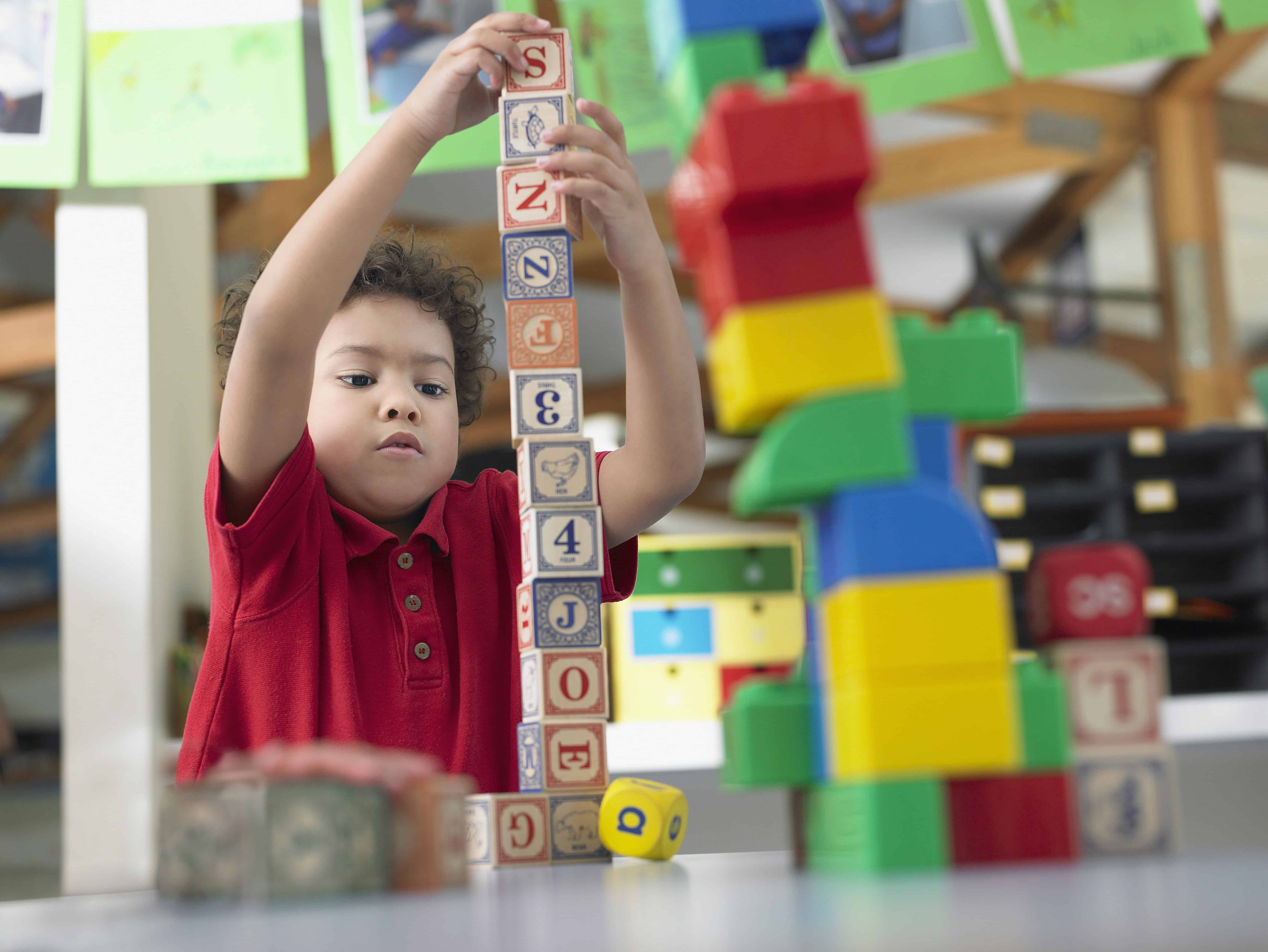
Another group of students is building with blocks on the floor. They are working together to build a tall tower. Another teacher is asking probing questions, like, “How many blocks have you stacked so far?” and “What will happen if we stack another block?”

As a naive bystander, you wonder if the kids here are learning anything. I mean, aren’t they just playing? What about all the preschool learning activities they’re supposed to be doing? Aren’t the teachers just playing with them? You start to wonder if preschool is really worth the money you’re paying for it.
Key Takeaways
The best preschools balance play with learning, employ warm and responsive teachers, and have low staff turnover. On a tour, pay attention to how the classroom is organized, whether children are actively engaged rather than just sitting and listening, how conflict gets handled, and how the school communicates with families. The 10 categories below walk through exactly what to look for, and why each one matters.
As a parent, you may have had a similar experience. Perhaps you were touring schools, wondering what to look for in a preschool or what questions to ask during a preschool visit. Perhaps you saw this scene as you waited for your child before pick-up time.
What Makes a High-Quality Preschool Program?
As adults, we often have preconceived notions about what “schooling” should look like and include. Doesn’t preschool mean a teacher in front of a group of kids, instructing them in the ways of ABCs and 123s? What is often missed is the subtlety of how children learn and the beauty of children’s development. Research and real-life experience tell us that all people learn best when they are actively engaged in preschool learning activities. This is especially the case for young children.
And what engaged kids more than anything else? Play! Although kids can learn through worksheets and flashcards, the lessons that benefit them the most and that they will keep in their little brains for years to come are those learned through hands-on engagement, which usually happens through play.

This post contains affiliate links. Purchasing through these links helps support this blog at no added cost to you.
A Parent’s Guide to Preschool
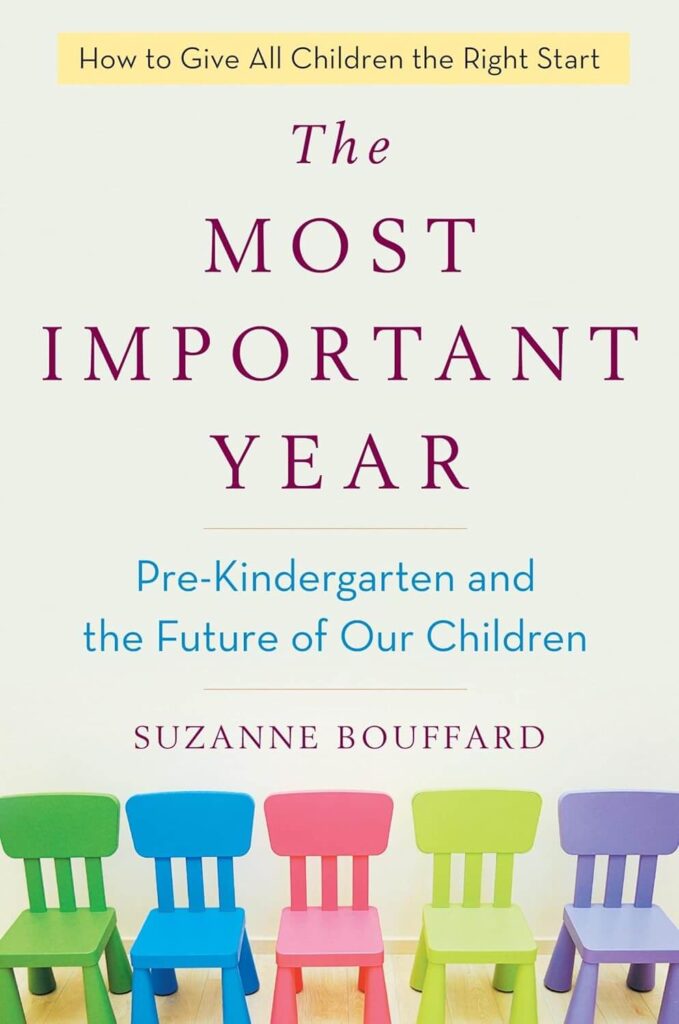
In her new book, The Most Important Year: Pre-Kindergarten and the Future of Our Children, author Suzanne Bouffard brings to light these issues of learning, play, and child development. This book is a must-read if you have a child approaching pre-K age.
It takes real skill to pack a lot of research into a book and make it not sound like a textbook. However, Suzanne Bouffard does it! She uses a wonderful storytelling style and incorporates the top research in the field in such a way that it’s enjoyable to read. You feel like you are just following along with a few families as they visit preschools. After reading this, you will know what to look for in a preschool. Crucial topics to consider include:

What to Look for in a Preschool: 10 Things That Actually Matter
1. The Play-to-Academics Balance
This is the big one. Walk into any preschool classroom and you’ll get an instant read on this: is the room set up for children to do things, or mostly to sit and listen? Research is pretty clear that young children build skills like problem-solving, language, and self-regulation through hands-on, playful experiences, not worksheets. That doesn’t mean academics have no place. It means the best programs weave letters, numbers, and reasoning into play rather than pulling kids out of play to drill them.
2. How Teachers Talk to Kids
Listen for the tone in the room, not just the curriculum. Are teachers asking open-ended questions (“What do you think will happen if…?”) or mostly giving directions (“Sit down. Put that away.”)? The way an adult talks to a 4-year-old in the middle of ordinary play tells you more about the quality of a program than almost anything on a brochure.
3. Teacher Turnover
I know this one doesn’t sound exciting, but it matters more than most parents realize. Young children learn trust and security through consistent relationships. A program that can’t keep teachers for more than a school year is often telling you something about pay, support, or working conditions behind the scenes, and that instability trickles down to your child.
4. How the Classroom Is Organized
Take a good look around the room itself. Are there clearly defined areas — a block corner, a dramatic play space, a reading nook — or is it one big open room with toys scattered everywhere? Thoughtful physical space isn’t decoration; it’s actually part of how preschoolers learn to make choices, focus, and regulate themselves.
5. What a Typical Day Looks Like
Ask to see (or ask about) the daily schedule. Is there a healthy rhythm of active and quiet time, big chunks of child-led play, and predictable routines? Or is the day chopped into short, rigid blocks moving kids from one adult-directed activity to the next? Preschoolers thrive on predictability paired with unhurried time to get absorbed in what they’re doing.
6. Outdoor Time and Movement
This gets overlooked constantly. Gross motor play like running, climbing, and digging isn’t a break from learning. For this age group, it is learning: body awareness, risk assessment, social negotiation (“it’s my turn on the swing”). A program that treats outdoor time as optional or an afterthought is missing something important.
7. How Conflict and Big Feelings Get Handled
Every classroom of preschoolers has meltdowns, grabbing, and tears — that’s just preschool. What matters is how the adults respond. Do they help children name feelings and work through problems, or is discipline mostly about time-outs and quieting kids down? This is one of the clearest windows into a program’s actual philosophy, whatever their mission statement says.
8. Communication with Families
You’re going to be partnering with these teachers for months, maybe years. How do they keep you in the loop: daily notes, an app, photos, a quick chat at pickup? And just as important: how do they handle it when you have a concern? A program that welcomes parent questions is telling you something good about how they operate.
9. Materials and Toys in the Room
Take note of what’s actually available to the kids. Are there open-ended materials like blocks, art supplies, dress-up clothes, loose parts. Or are there mostly single-purpose toys and worksheets? Open-ended materials tend to invite the richest kind of play, the kind where children are directing their own learning.
10. Licensing, Accreditation, and the Basics
Not the most exciting item on the list, but a necessary one. Every state has licensing requirements, and many high-quality programs also pursue accreditation (through organizations like NAEYC) that goes beyond the legal minimum. It’s worth knowing where a program falls before you fall in love with the cute artwork on the walls.
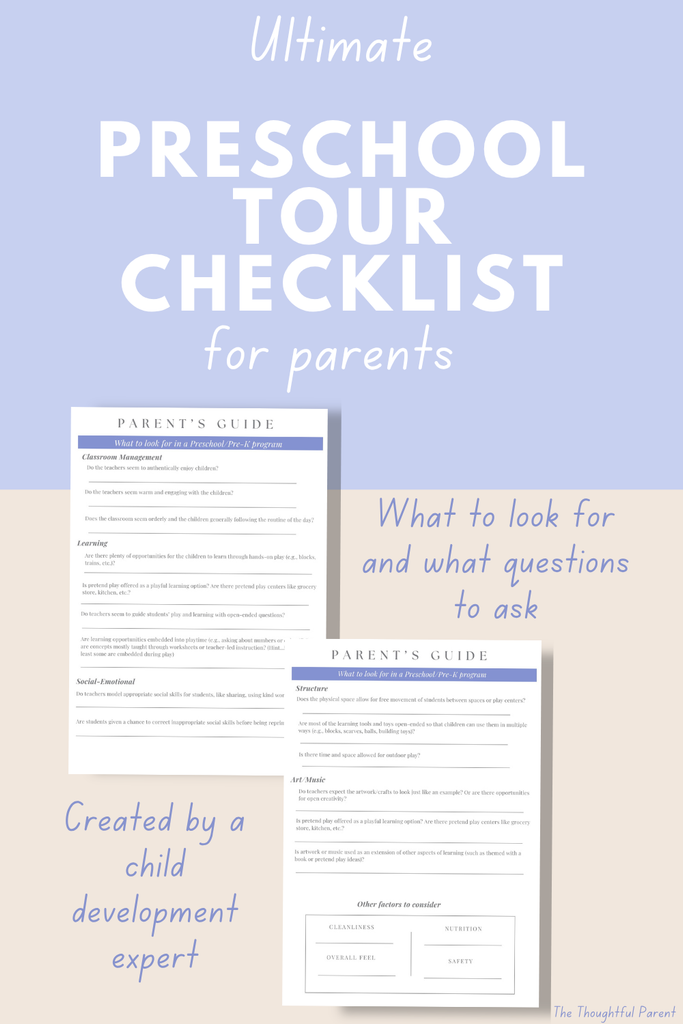
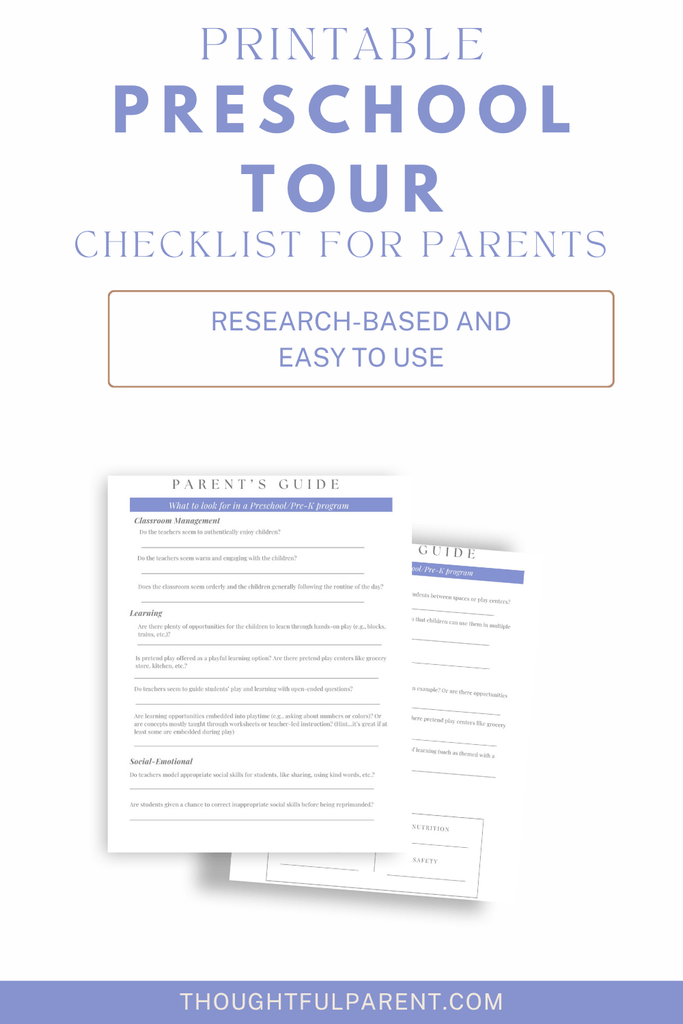
Ready to actually put this into practice on a tour? This Preschool Checklist for Parents turns these categories into the exact questions to ask and what to watch for in each area of the classroom — so you’re not scrambling to remember all of this in the moment.
FAQs About Choosing a Preschool or Pre-K
Focus on how the classroom balances play and academics, how teachers talk to and engage with children, staff turnover, the physical setup of the room, and how conflict and big feelings get handled. The daily schedule and how the school communicates with families matter too. I break down all 10 categories above — and if you want the exact questions to ask in each area, grab my Preschool Checklist for Parents.
For most 3- to 5-year-olds, play-based programs tend to build stronger long-term skills like language, problem-solving, self-regulation. These are usually better than programs built around worksheets and direct instruction. The best programs don’t treat this as either/or; they weave letters, numbers, and reasoning into hands-on play rather than pulling kids out of play to drill them.
Enough to cover the classroom environment, teacher-child interactions, daily routine, and communication style, but you don’t need to memorize a long list on the spot. I put together a full, organized set of tour questions in my Preschool Checklist for Parents so you can just bring it with you.
Outside of obvious health or safety concerns, be aware of classrooms where children are mostly sitting and listening rather than doing, teachers giving directions instead of asking open-ended questions, high staff turnover, chaotic or under-stocked materials, and little to no outdoor or movement time. Any one of these alone isn’t necessarily disqualifying, but a few together are worth taking seriously.
Preschool checklist for parents
Download this Preschool Checklist for Parents. All your preschool visit questions are ready to go!
Related reading and resources:
Fun and Effective Executive Function Activities for Preschoolers
“Aren’t They Just Playing?” The Subtle (but Amazing) Way Play-Based Preschool Ignites Learning
Leave a Reply