

The development of emotional regulation in toddlers takes a lot of modeling and patience on the part of parents. Although little boys are thought to develop self-regulation skills later than young girls, research shows that language skills can help make up this difference.
Many a parent of a toddler or even preschooler has encouraged their child to “use your words” in dealing with a problem or request, instead of crying, acting out, or whining. What happens, however, if the child doesn’t have the words? Toddlers’ little brains are not only learning emotional regulation skills at this young age, but language almost simultaneously. We’ve known for decades that self-regulation in toddlers is a crucial aspect of their emotional development, but only recently have researchers considered the role of language.
Key Takeaways
Self-regulation is a toddler’s developing ability to manage emotions, behavior, and attention. It emerges gradually between ages 1 and 5, not all at once.
Language skills are closely tied to self-regulation. Kids with stronger vocabularies tend to self-regulate better, likely because words give them a way to express needs instead of acting out.
This connection matters more for boys. Research published in Early Childhood Research Quarterly found that language skills predict self-regulation more strongly in boys than in girls; boys with strong language skills can self-regulate as well as girls the same age.
Tantrums and big emotions are developmentally normal, especially before age 3. What matters most is the trend over time, not any single meltdown.
You can actively support this skill through modeling, not punishing emotions, and practicing self-regulation through simple games like Simon Says or Red Light, Green Light.
What Is Self-Regulation, Exactly?
Self-regulation is a child’s growing ability to manage their emotions, behavior, and attention — especially when they’re upset, frustrated, or overstimulated. For toddlers and preschoolers, this doesn’t look like calm, adult-style coping. It looks like:
- Taking a breath (even a shaky one) before reacting
- Waiting a few extra seconds for a turn
- Using words like “mad” or “no” instead of hitting or screaming
- Recovering from a meltdown without hours of aftermath
It’s important to remember that self-regulation isn’t something toddlers either “have” or “don’t have.” It’s a skill that develops gradually, with a lot of regression along the way. A two-year-old who falls apart over the wrong color cup isn’t failing at self-regulation; they’re right where we’d expect a two-year-old to be.
It turns out that teaching self-regulation through language is especially helpful for boys. A recent study published in Early Childhood Research Quarterly found that language skills are more important in the development of self-regulation skills in young boys than young girls.
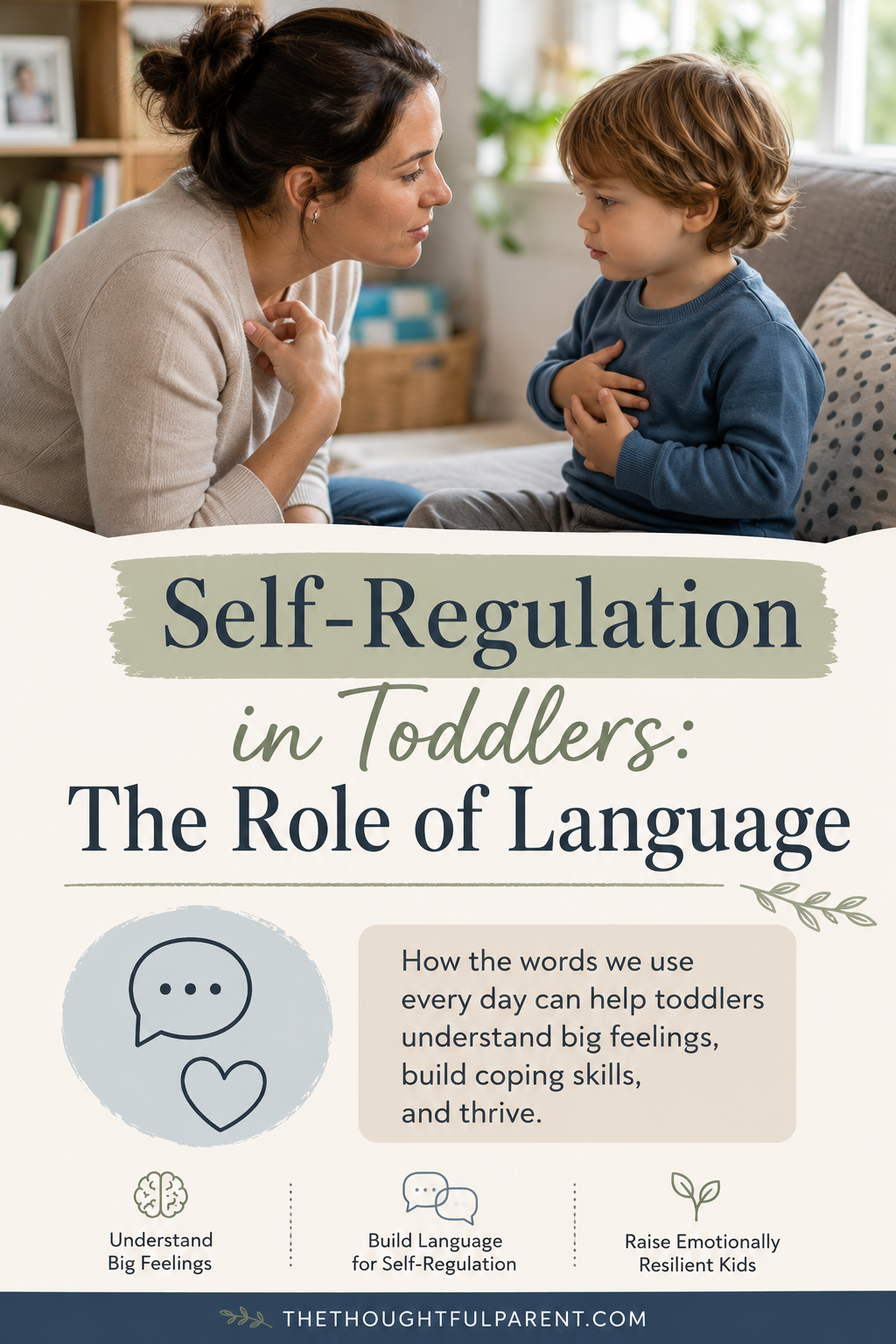
The study looked at children as they developed from age 1 to 3. As previous research has shown, this study replicated the finding that language skills, particularly vocabulary, help kids regulate their emotions and behavior. Research has often found that girls are typically more advanced in their language skills and thus self-regulation skills at this young age. What was different about this study, however, is that it showed that toddler and preschool boys with strong language skills can be as skilled in self-regulation as girls at this age.

Download Emotion Camp now
Why Emotional Regulation Matters
What’s so important about emotional regulation in preschoolers and toddlers? Well, besides the obvious encounters in daily life (e.g., not running out in the street), self-regulation has been highlighted as one of the key aspects to success in school, career, and life. Ellen Galinsky, in her book Mind in the Making
“Focus and self-control involve many executive functions of the brain, such as paying attention, remembering the rules, and inhibiting one’s initial response to achieve a larger goal. Scientists call these executive functions because these are the brain functions we use to manage our attention, our emotions, and our behavior in pursuit of our goals. Many scientists now believe that executive functions predict children’s success as well as—if not better than—IQ tests.”
So it seems the early development of self-regulation skills can only help our children as they move through life.
Self-Regulation Milestones by Age
Every child develops at their own pace, but here’s a general roadmap of what self-regulation tends to look like at different ages:
12–18 months: Babies start to show early signs of self-soothing, like sucking their thumb or seeking a comfort object. They rely heavily on caregivers to help them calm down (called “co-regulation”) and have very little ability to manage big feelings on their own.
18–24 months: Toddlers begin to understand simple rules (“hot,” “no touch”) and may start using short phrases as self-talk, similar to the “no, no” example above. Tantrums are common and expected at this age — the brain’s emotional centers are far more developed than its self-control centers.
2–3 years: Vocabulary starts to catch up with emotion. Toddlers can begin to name basic feelings (“mad,” “sad”) when prompted, and may start using simple calming strategies if they’ve been taught and practiced them (like taking a “big breath”). Impulse control is still very limited.
3–4 years: Preschoolers can typically wait for short periods, follow two-step directions, and use language more independently to express needs instead of acting out. Self-regulation is still fragile, especially when a child is tired, hungry, or overstimulated.
4–5 years: Most children can identify a wider range of emotions in themselves and others, use taught coping strategies with some consistency, and begin to manage transitions (like leaving the park) with less distress, though meltdowns still happen.
These ranges are general guidelines, not a checklist — kids move through them at very different speeds, and boys, as the research above suggests, may need more explicit language support to get there.
Reading this study reminds me of a phase with my then 16-month-old son. Even at that young age, I remember beginning to see how language helped him with emotional regulation and self-control. He was starting to learn that certain items were off-limits (e.g., trash can, toilet), and when he got close to them, he would say “no, no” to himself. This “self-talk” is the early stage of the development of self-regulation. 
Related reading: Social-Emotional Development in Kids: A Parent’s Guide
Of course, at this age, he was not always successful in staying away from these items, but at least he was learning. As he learned more vocabulary, he was able to say what he needed or wanted, as well as continue this internal dialogue to help him control his actions. I think it is helpful to know that boys can use language skills to support self-regulation at the same level as girls. Although girls usually have a natural tendency to pick up language earlier, it is important to encourage language skills as much as possible with boys, too.
Here’s a video I made in my Facebook Group all about this bit of research, as well as how language plays a role in self-regulation throughout the lifespan:
Signs Your Toddler May Be Struggling with Self-Regulation
Big emotions are a normal part of early childhood, but some patterns suggest a child could use extra support:
- Tantrums that are frequent, intense, or long-lasting well beyond what’s typical for their age
- Difficulty calming down even with a caregiver’s help (co-regulation isn’t working)
- Aggression (hitting, biting, throwing) that isn’t decreasing as language develops
- Extreme distress over small changes in routine
- Trouble with transitions that doesn’t improve with practice and predictability
- Emotional outbursts that seem to come from nowhere, without an identifiable trigger
Seeing one or two of these occasionally is normal toddler behavior. It’s the frequency, intensity, and lack of improvement over time that matter more than any single episode.
How Can I Help My Toddler Self-Regulate?
Helping foster emotional regulation in toddlers is one of our crucial tasks in those early years of parenting.
- Focus on giving kids strategies to build their own self-regulation instead of always being a source of external regulation for them. As parents, this could mean holding space (as hard as it is) during a tantrum, but also teaching skills like breathing techniques or practicing a difficult situation at home before going out.
- Not punishing emotions. Kids’ difficult emotions are challenging for parents to handle, as well as kids. By not punishing difficult emotions like anger or frustration, but instead helping kids learn how to work through them, you can foster lifelong skills.
- Play games that require self-regulation. For young kids, classic games like Freeze Dance, Simon Says and Red Light, Green Light can help build self-control. Activities that allow kids to practice executive function skills and self-regulation are a wonderful way for kids to learn these skills.
Related reading: Fun and Effective Executive Functioning Activities for Toddlers and Preschoolers
When Should I Be Concerned About My Child’s Self-Regulation?
Most self-regulation struggles in toddlers and preschoolers are developmentally normal and improve with time, language growth, and consistent support. However, it may be worth talking to your pediatrician or a child development specialist if you notice:
- Meltdowns that are escalating in frequency or severity past age 4
- Self-regulation difficulties significantly interfering with preschool, daycare, or friendships
- A big, sudden change in behavior with no clear cause
- Aggression toward self or others that’s increasing rather than decreasing
- A general sense that your child’s reactions are consistently more intense than their peers’
Trust your instincts here. You know your child better than any article or checklist. A conversation with your pediatrician costs you little and can either offer reassurance or connect you with helpful early intervention resources — and earlier support tends to be more effective than waiting.
Favorite Self-Regulation Activities and Games:


Frequently Asked Questions About Toddler Self-Regulation
Self-regulation begins developing as early as 12–18 months and continues to mature through the preschool years and beyond. Most children show noticeable gains in self-regulation between ages 3 and 5, as language skills grow.
Research suggests it’s less about boys having weaker self-regulation ability and more that girls tend to develop language skills earlier. Language plays a major role in helping young children manage emotions and behavior. When boys have strong language skills, their self-regulation abilities can match those of girls the same age.
Self-control usually refers to resisting an impulse in the moment (like not grabbing a toy). Self-regulation is broader. It includes managing emotions, attention, and behavior over time, and recovering after becoming upset.
Stay calm yourself, use simple language to name what they’re feeling (“You’re really frustrated”), and avoid trying to reason with them until the intensity passes. Teaching breathing or calming strategies works best when practiced during calm moments, not in the middle of a tantrum.
Related Parenting Resources:


Leave a Reply