
By Amy Webb, PhD, Human Development and Family Sciences (and mom of two_
Remember when you first brought your baby home? If you’re like me, you suddenly found yourself Googling everything about baby development. You probably know the typical types of developmental milestones but what about those overlooked developmental milestones that no one talks about?

Even though my background is in child development, the nerves and sleep deprivation of early parenthood left me with a foggy brain and dizzy with questions. All the parenting books and websites usually have the standard developmental milestones covered: rolling over, walking, first words, etc.
Related reading: Fascinating Newborn Reflexes that May Surprise You
As a developmentalist, I began to notice that the smaller, more subtle types of developmental milestones are often overlooked in the parenting books. For example, remember the first time your child was able to hug you back when you hugged them? Or the first time they blew “raspberries” in such a silly way that you broke into laughter?
Key Takeaways
Quick answer: Beyond the well-known milestones like walking and first words, child development experts point to several subtler ones: object permanence (6–8 months), attachment to a comfort object (10–12 months), mirror self-recognition (around 18 months), and theory of mind (3.5–4 years). These milestones are easy to miss, but they mark major shifts in how your child understands the world.
These overlooked milestones may not make it into the parenting books, but they mean the world to you. So I’ve compiled a must-have list of often-overlooked child development milestones to help you savor a few more aspects of your child’s development. These are often not apparent to some parents unless you know what to look for.
For parents who also teach, keeping track of school-day details can be another small source of mental clutter. An easy grader can quickly calculate a percentage and letter grade, leaving more time to notice and enjoy the everyday milestones that are easy to miss.
Most of these milestones are subtle because they have to do with your child’s cognitive development and changes in how they understand the world. These aren’t always easily seen, but if you observe closely, you might just see evidence of them.

4 Often-Overlooked Developmental Milestones in Young Children
Object Permanence
Object permancence is a child’s ability to know an object or person still exists even when it cannot be seen.
One clear sign that your baby has developed this skill is if they look for a toy that’s hidden under a blanket. This usually develops around 6-8 months of age.
The development of this skill sometimes coexists with an increase in separation anxiety. Since your baby now knows you still exist even when you aren’t present, they may protest or cry when you leave.
Theory of Mind
Theory of Mind is the ability of a child to understand the perspective or thoughts of another person.
When your child’s hasn’t yet developed Theory of Mind, they may do things like list their favorite food, color, etc. as your favorite. They do not yet understand that you have different thoughts than them.
This skill usually develops around age 3.5 to 4.
Recognize Self in a Mirror
Self-awareness is sometimes measured by a child’s ability to recognize that the person reflected in a mirror is actually herself, not another person.
This is one measure of self-awareness (although not the only one)
Typically, this skill is tested by putting lipstick on a baby’s face and placing her in front of a mirror. If she grabs at her own face to rub the lipstick, then it is thought that she has developed self-awareness.
This skill usually develops around 18 months of age.
Attachment to a comfort object
Although not all kids become attached to a “lovey” it is a common behavior that helps young children feel comforted and safe.
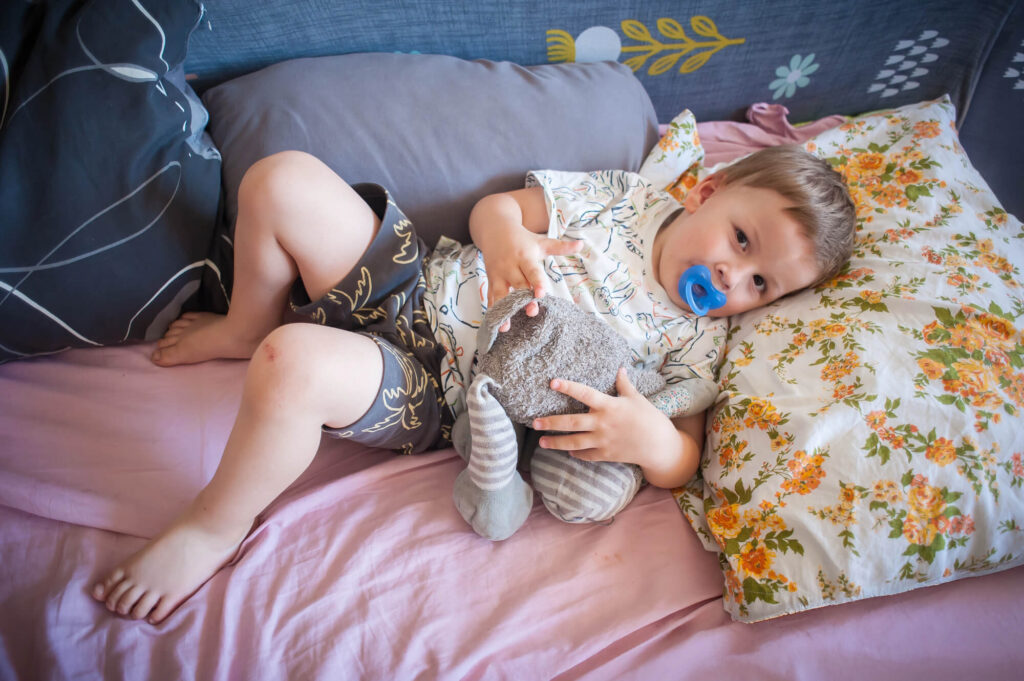
The attachment object can be almost anything—blanket, toy, stuffed animal, etc.
This behavior usually develops around the age of 10-12 months.
| Milestone | Typical Age | What to Look For |
|---|---|---|
| Object Permanence | 6–8 months | Looks for a toy hidden under a blanket instead of losing interest |
| Attachment to a Comfort Object | 10–12 months | Seeks out a specific blanket, stuffed animal, or toy for comfort |
| Mirror Self-Recognition | ~18 months | Touches their own face (not the mirror) when they spot a mark on it |
| Theory of Mind | 3.5–4 years | Understands that others can have different thoughts, likes, or knowledge than they do |
Want to learn more about your child’s development? Interested in research-backed parenting tips? Sign up for my Substack newsletter!
FAQs About Overlooked Milestones
Object permanence typically develops between 6 and 8 months. You’ll usually see it when your baby starts searching for a toy that’s been hidden under a blanket instead of acting like it’s disappeared.
Theory of mind is a child’s ability to understand that other people have their own thoughts, preferences, and perspectives that differ from their own. It usually develops around age 3.5 to 4. Before that, a child might assume their favorite food or color is also yours.
Most children develop mirror self-recognition around 18 months. It’s often tested with a “mirror test,” where a parent puts a small mark (like a dot of lipstick) on the child’s face. If the child reaches for their own face rather than the mirror, that’s a sign of self-awareness.
Attachment to a “lovey” — a blanket, stuffed animal, or other object — usually develops around 10 to 12 months. It helps young children feel safe and soothed, especially during transitions or separation from a parent.
Leave a Reply