
Sneak peek: Learning how to be a happy stay-at-home mom can be a struggle for many of us. Read on for tips and ideas for not just surviving but thriving as a stay-at-home mom.
After being a stay-at-home mom for over 10 years, I’ve learned that it is a role full of paradox. Yes, it is a privilege to be able to be with my kids each day. And it’s also true that being a stay-at-home mom involves a lot of sacrifices. The key for how to be a happy stay-at-home mom is making peace with this paradox and all that comes with it.

Key Takeaways
A stay-at-home mom can find real, lasting happiness by focusing on three things: setting boundaries around her time and mental energy, building small consistent self-care habits into her day, and shifting her mindset to recognize the value of the work she’s doing. None of these require big life changes — they’re small, repeatable practices that add up over time.
Recognizing that being able to stay home with our kids is a privilege doesn’t mean you have to enjoy every minute of it. Being a stay-at-home mom is challenging. There is no getting around that. We sacrifice our careers, much of our free time, and our own agendas to be stay-at-home moms. I think what most of us recognize, however, is that these sacrifices are somewhat temporary. Ultimately, as our kids mature, we return to careers or creative outlets. The time we spend with our kids when they are young is irreplaceable.
Related reading: What Research Says is the Best Stay-at-Home Mom Schedule for Kids {and moms too!}
How Can a Stay-at-Home Mom be Happy?
When I reflect on what I’ve learned over the years about enjoying being a stay-at-home mom, it mostly involves finding balance. As a stay-at-home mom, it’s easy to give all of yourself 24/7 to your kids and forget about your own interests and well-being. Stay-at-home mom life doesn’t have to be that way. We can keep a piece of ourselves alive and well, even while giving so much to our kids.
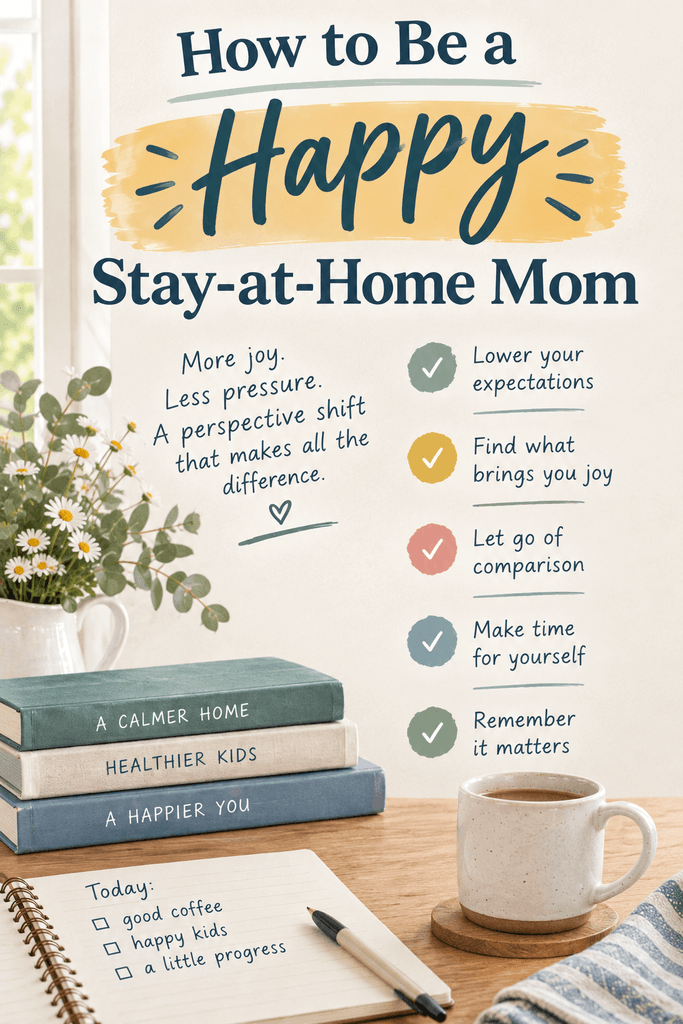
A few consistent practices that have helped me learn how to be happy as a stay-at-home mom include things like:
- boundary-setting,
- building in time for self-care (that relates to boundaries too!) and
- changing my mindset to recognize the importance of the work I do each day
Related reading: How Reading Classic Books Can Powerful Form of Self-Care {for kids and adults!}
While these may sound simple, implementing these habits of mind can be challenging for stay-at-home moms.
Boundary-Setting for Stay-at-Home Moms
When we think of boundary-setting, we often think of setting boundaries with our kids, and that is important. Boundary-setting for moms often includes knowing when to say “no.” This could mean saying no to too many commitments, such as too many kids’ activities, or saying no to certain negative thoughts that run through our minds.
Here’s what boundary-setting has actually looked like for me, in practice:
Have a go-to phrase ready. When someone asks me to volunteer for the third bake sale that month, or a friend wants to schedule a playdate during my one quiet hour, I don’t try to improvise a polite no on the spot. If you tend to be a people-pleaser, like me, you know this is hard.
Instead, I have phrases ready ahead of time. Something like, “That doesn’t work for us right now, but thank you for thinking of us,” or simply, “I can’t take that on this busy season.” Having the words prepared means I don’t cave just because I’m caught off guard.
Don’t let false guilt drive the decisions. Setting a boundary doesn’t stop the guilt, but if you’ve made a decision from a place of strength, this is really false guilt. I still feel a pang when I say no to my kids, or when I choose my own nap over one more chore. What’s changed is that I don’t let the sense of false guilt drive the show.
Read more: Why We Feel So Guilty as Parents and How to Overcome It
Set boundaries with your own inner critic. Boundary-setting for stay-at-home moms isn’t only about other people. So much of my mental energy used to go to the voice in my head listing everything I should be doing better. Now, when that thought pattern starts, I try to name it, instead of following it all the way down. That’s a boundary too.
Revisit your boundaries as your kids’ ages change. What worked when my boys were toddlers doesn’t work now that they’re older. I’ve learned to treat boundaries as something I reassess every few months, not something I set once and forget.

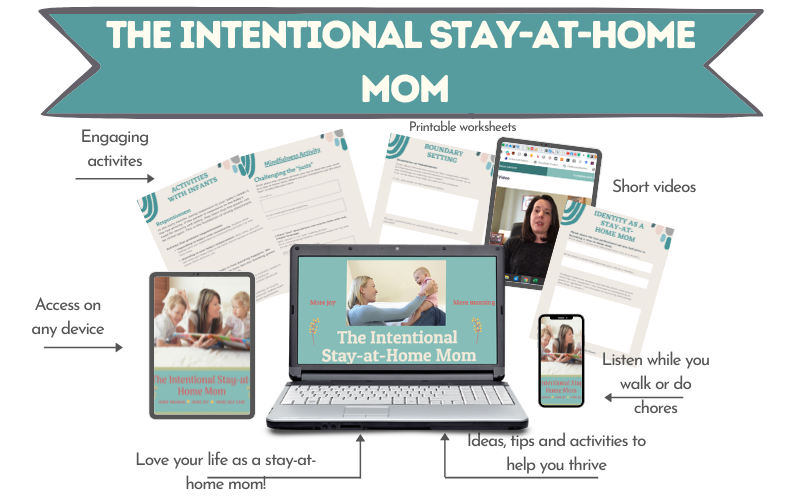
Need more support to live out these tips? I’ve designed a course just for stay-at-home moms! Updated for 2026 –>> Join today
Self-Care for Stay-at-Home Moms
For many stay-at-home moms, self-care is virtually nonexistent. Many mothers have the impression that giving everything to their kids (e.g., physical duties, emotional strength, time, energy, etc.) means they are “good” moms. When I started my journey as a stay-at-home mom, I thought this too. I thought if I just gave my kids my everything, then they would turn out “perfect.”
What 11 years of experience has now taught me is that we can support and guide our kids, but their choices and ultimately their development are their story, not mine. As the old saying goes, “You can’t pour from an empty cup,” and this is very true for motherhood. As stay-at-home moms, we must find little ways to fuel ourselves, our needs, and our personalities if we are to have anything to offer our children.

Here’s what that’s actually looked like for me:
Start smaller than feels worthwhile. I used to think self-care had to be a whole event: a spa day, a weekend away, something Instagram-worthy. Most days, my actual self-care is five minutes with a cup of coffee that’s still hot when I drink it, or one chapter of a book before the house wakes up. It doesn’t need to be big to count. It needs to be consistent.
Build self-care it onto something that already happens. The self-care habits that have stuck for me are the ones I attached to an existing part of my day. For example, a short walk during the one nap that still happens, a podcast during the drive to pick up the kids, stretching while dinner cooks. I stopped waiting for a free block of time to magically appear, because it rarely did.
Let go of the idea that rest has to be earned. I spent a long time believing I could rest once everything on the list was done, but the list is never done. Giving myself permission to rest before I “deserved” it changed more than any specific self-care activity did.
Find one thing that’s just yours. Somewhere in the early years, it’s easy to lose track of what you even like anymore, separate from your kids. For me, it’s been this blog and going back to books that have nothing to do with parenting (for me that’s mystery novels!). Having even one small interest that belongs only to me reminds me I’m still a whole person underneath the role of “mom.”
Mindset for Stay-at-Home Moms
Although not often discussed in mom circles, changing your mindset is crucial to being happy as a stay-at-home mom. Let’s face it, the stereotype of stay-at-home moms in our culture is not so great. Our role in society is not well-respected or even well-understood. Stay-at-home moms are often depicted as caring and loving but also simplistic, unintelligent, hypervigilant about their kids’ well-being, and sometimes even spoiled.
Although in reality, none of these stereotypes are even close to accurate, I think this image often seeps into moms’ mindsets. They begin to see themselves and the work they do at home as unimportant, not relevant, and not contributing to society as much as parents who work outside the home. This mindset often contributes to stay-at-home moms not feeling as fulfilled in their role as they could feel.
This is where mindset change is crucial. Altering your mindset (and reminding yourself regularly) to see the valuable work that you do with our kids each day can change everything.
Name what the job actually requires. When I catch myself minimizing what I do, I try to name it in concrete terms: I’m managing a household’s logistics, shaping how two people learn to regulate their emotions, and making dozens of decisions a day about their development.
Notice when you’re comparing your inside to someone else’s outside. It’s easy to measure my hardest, most chaotic days against someone else’s highlight reel. I try to remind myself I’m not actually seeing their hard days, just like they’re not seeing mine.
Read on:
Separate your worth from your output. Some days involve very little visible “productivity”: no errands checked off, no craft finished, just holding a cranky toddler for an hour. I’ve had to actively practice believing those days still count, instead of measuring my value as a mom by how much got done.
Surround yourself with people who see the role clearly. The friends and communities I keep close now are ones who don’t ask “so what do you do all day” with that tone. Who you let define the role for you matters more than you think.
Need more tips for raising kids in today’s world? Sign up for my Substack newsletter:
Frequently Asked Questions about Stay-at-Home Motherhood
SAHM burnout usually comes from a mix of constant availability, lack of boundaries, and the belief that self-care has to be “earned” after everything else is done. It’s rarely one big thing. It’s the accumulation of small sacrifices with no real recovery time built in. In my experience, burnout crept in fastest during the years I felt the most guilt about taking anything for myself.
Start by naming the actual scope of what you do in concrete terms, rather than minimizing it as “just staying home.” You’re doing important work each day: you’re managing logistics, shaping how your kids handle emotions, and making constant decisions about their development.
Yes, completely normal. Feeling frustrated, lonely, or even resentful at times doesn’t mean you’re ungrateful or bad at this. It means you’re human, and the role asks a lot of you. In my 11 years doing this, I’ve never met a stay-at-home mom who felt happy every single day.
Leave a Reply