
Sneak peek: A review of the book The Curiosity Cycle with tips for how to foster your child’s curiosity through everyday activities.
Now, on to the main event. I recently had the chance to review a new book entitled The Curiosity Cycle: Preparing Your Child for the Ongoing Technological Explosion. The title intrigued me because, although I read quite a few parenting/child development books, the topic of technology is not one I have focused on yet. The author, Jonathan Mugan, has a background in psychology and computer science. Interesting combination, right? I wouldn’t have necessarily thought about a computer scientist writing a book oriented towards parents but as it turns out, he offers an insightful approach to the topic.
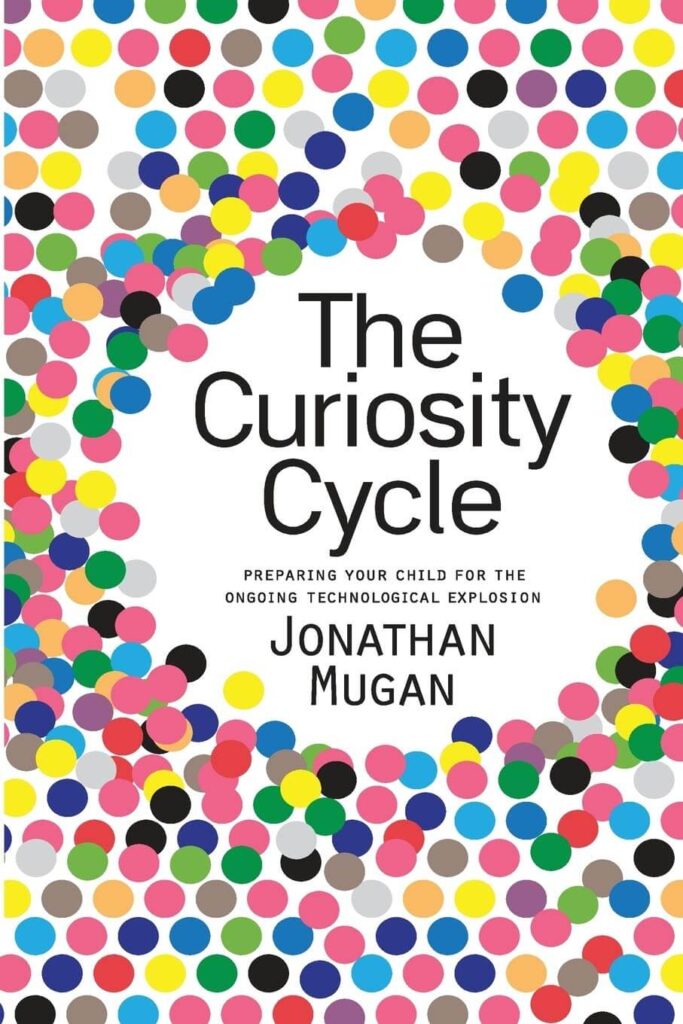
The book opens with a thorough description of the curiosity cycle and how children use this to make sense of the world around them. For those of you, like me with some background in psychology, the curiosity cycle sounded a lot like the development of a schema.
Children use their innate curiosity about the world to gather information to form a model for understanding an idea or concept (e.g., a dog). As they encounter more experience in the world, their model of what a “dog” is may have to be modified based on new information. Although many of us may not have thought about this process in such analytical terms before, I think we have all seen this happen with our children.
Mugan then addresses different areas of life in which the curiosity cycle is useful and how parents can encourage and maximize their children’s curiosity. Fortunately, the curiosity cycle tends to feed on itself so that the more curious kids are, the more they learn and then become curious about more things in their world.

The second part of the book addresses how the curiosity cycle has applications in the social, physical, emotional, and mental aspects of life. Throughout this section, Mugan offers very helpful “games” or strategies that parents can use to encourage not only curiosity but critical thinking in their children. This was probably my favorite aspect of the book. The examples Mugan provides are not flashcards or formal exercises but everyday activities and conversations with children that parents could easily incorporate into their day. For example, one suggestion Mugan describes is pointing out to children the amazing aspects of everyday life. He says,
“Consider the marvel of McDonald’s. Imagine that you were talking to a caveman who had spent all day hunting a woolly mammoth with nothing to show for it but a broken arm and some bruised ribs. You can tell him that there is this place where you walk in and order any food you want, as much as you want, and they give you the hot food you ordered and then they thank you.”
I think these kinds of strategies are great. Helping kids understand the amazing aspects of everyday life not only fosters an attitude of gratefulness but also prompts their interest in how these things came into existence. Through examples like these and other types, Mugan can offer parents ideas on how to encourage skills such as goal-setting, self-efficacy, creativity, and self-control.
Related reading: How to Give Your Child a 1980s Childhood {and it’s backed by research!}
At this point, you may be wondering what all this has to do with technology. In the last chapter, Mugan makes the connection between the curiosity cycle and the ever-changing technological landscape that our children will face.
To me, it comes down to this: unless a child (or adult) is curious and thinks critically, there is a good chance in the future that their role/job could be replaced by a computer.

Mugan puts it this way, “Increasingly, your child will be evaluated less on the ability to regurgitate information, because computers can do that now, and more on the ability to create new things.” The role of the curiosity cycle, then, is to help children learn the critical thinking skills necessary to effectively gather and use the information and technology that is available to them.
I feel this is the key point of the book. An authentic, in-depth curiosity of the world is what our children will need to function well in the future. I find this point especially important in the atmosphere of standardized testing that seems to dominate our education system at this time. Although I think strides are being taken to incorporate more critical thinking skills into the educational process, in many places, the push towards standardized testing has served to undermine the curiosity cycle. But that’s another topic for another post.
Needless to say, I enjoyed this book and felt it was a unique approach to the topic. If you have an interest in fostering your child’s curiosity (and what parent doesn’t), then take a look at this book.
Melissa Taylor
I have this book on my stack to read . . . thanks for the review. And, a BIG thanks for guest posting on Imagination Soup!
Suzita @ playfightrepeat.com
The Curiosity Cycle sounds really good. Thanks for reviewing it! The themes it explores remind me of those in Daniel Pink's book, A Whole New Mind: Why Right-Brainers Will Rule the Future. However, Pink's book is geared a bit more toward adults. I look forward to reading one for parents and kids.
karen
Thanks for posting such an interesting review. I will definitely want to take a look at this book. It seems right in line with my interests about how we can help children to become more creative thinkers.