
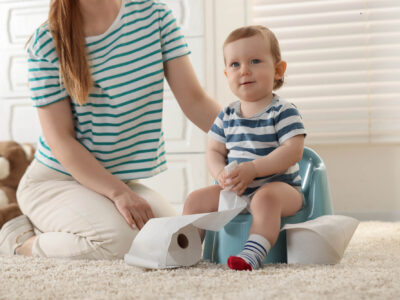
What Research Actually Says
Sneak peek: As your child approaches toddlerhood, a common question that comes up is, “When do you start potty training?” I’ve done the research for you and summed up the best potty training advice.
If you’re wondering, “When do you start potty training?” you’re in good company.
It’s one of those parenting questions that seems like it should have a simple answer, but doesn’t because each child is unique.
There isn’t one perfect age. There’s more of a window—and hitting that window matters more than starting early. It’s more about watching for your child’s signs of readiness than picking a perfect age arbitrarily.
What research says about beginning potty training
Most children begin potty training a little after their second birthday.
A 2024 study on toilet training readiness found the average start age was 26.8 months, which lines up with broader research showing that most kids start somewhere between 24 and 36 months.
That means if your child is around age two and you’re starting to think about it, you might be on a good path.
But here’s the part that often gets buried in the research:
Starting earlier doesn’t mean finishing sooner.
In fact, the research shows the opposite. Starting early—before about 18 months was correlated with a longer potty training process. But waiting too long, past about 30 months, can also make things harder, with more resistance and delays.
So if you’re asking “When do you start potty training?”, the most accurate answer is:
Consider starting around age two—but only if your child seems ready.
Quick Answer: When Do You Start Potty Training?
Most children start potty training between 24 and 36 months, with the average age around 26–27 months. The best time to start is when your child shows readiness signs like staying dry for longer periods, communicating needs, and showing discomfort with dirty diapers.
Why potty readiness matters more than age
You’ve probably heard this before: “Look for signs of readiness.”
That advice is solid, but also a bit oversimplified.
What’s surprising is that researchers don’t even fully agree on which readiness signs matter most. Some studies list more than 20 different indicators, from physical abilities like walking and sitting, to communication skills, to showing interest in the bathroom.
But one signal stands out more than the others. In the 2024 study, this factor predicted successful training more than the others:
Children who show discomfort in a dirty diaper. That is, they clearly don’t like the feeling of being wet or soiled. Children who show this sign tend to train more successfully.
That discomfort signals something important: awareness. It means your child isn’t just physically capable, but mentally tuned in to what’s happening in their body.
And that internal awareness is what makes potty training click.
Not sure if your child is ready to start potty training?
Take our Potty Training Readiness Quiz!
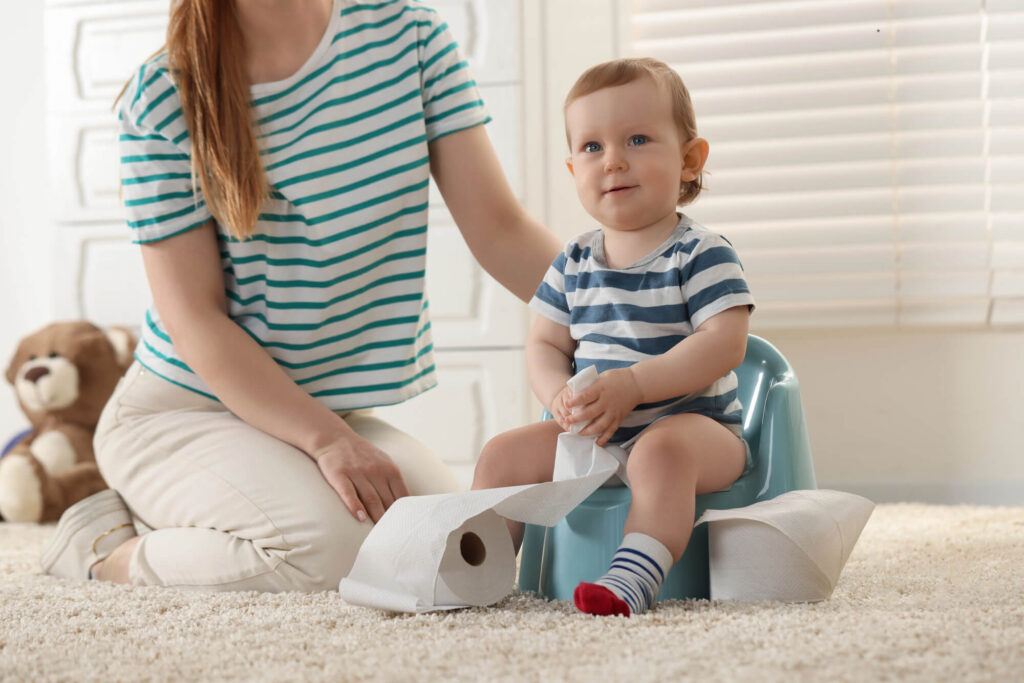
What actually makes potty training easier (or harder)
A lot of advice focuses on methods—three-day programs, reward charts, sticker systems.
But research suggests something more foundational is at play.
Timing, readiness, and consistency matter more than any specific method.
Children who start at the right developmental moment tend to learn faster. Children who aren’t quite ready often take much longer, sometimes more than a month longer, according to recent data.
Consistency also plays a bigger role than most parents expect. When potty training is interrupted by travel, schedule changes, a new sibling, or just life, it can significantly slow things down.
Related reading: The Preschool Tour Checklist
Other factors that influence potty training
Here’s where things get especially interesting.
Some research suggests that family routines and structure influence how quickly children learn. Kids in more predictable, consistent environments tend to have an easier time. This makes sense because potty training is really potty learning. It takes consistent practice and making it a routine for it to stick.
There are also real-life factors: sometimes you may feel pressure to potty train your child, even if they don’t seem completely ready. Many daycares or preschools require that children be potty trained before starting. This really puts the pressure on to finish on a particular timeline. While this may not be a perfect scenario, it’s also not horrible. Potty training has to happen one way or another and if you have to start a little sooner than you’d like, it’s okay. Your child will eventually get the hang of it.
Both my boys started preschool only partially potty trained, but it was okay. They didn’t have many accidents since they were only there for about 3-4 hours a day. Work with your child’s daycare or preschool teacher and communicate about your child’s progress.
What happens if you start potty training at the “wrong” time?
Although watching for your child’s readiness is key, try to put aside the concern of starting at the “wrong” time. Children are complex and it’s sometimes difficult to read the signs.
It’s true that starting too early can lead to frustration, accidents, and sometimes make the process take a bit longer. That’s okay.
Starting too late can bring its own challenges, like resistance or power struggles. But, starting later may also be easier in some ways because your child will likely be able communicate with your more easily.
There are pros and cons both ways. The key is to really look for signs of readiness in your child and above all, be patient. Potty training is a process. Although some “experts” claim that you can do it in a weekend, in my experience, that is not typical for all children. Some children, like mine, take a long time to get on board with potty training.
It’s important to keep in mind that the age at which your child successfully completes potty training is predictive of…nothing. It has nothing to do with their intelligence, ability to learn, etc.
The big picture on potty training
If you zoom out, the answer becomes clearer.
Most children are ready sometime between 24 and 30 months. The best time to start is when your child is showing signs of awareness, communication, and willingness…and when you can commit to staying consistent.
Instead of asking, “When do you start potty training?” it may be more helpful to ask:
“Is this the right moment for my child?”
Because when the timing is right, potty training tends to move faster, feel easier, and involve far less stress for everyone involved.
Potty training isn’t really about picking the perfect method or hitting the perfect age.
It’s about timing and being responsive to your unique child. I’m sorry to say, but like with many aspects of parenting, there are no magical shortcuts.
When your child is ready and open to learning everything will fall into place.
Potty Training FAQs
Most experts recommend waiting until at least 18–24 months, when children begin developing the physical and cognitive skills needed.
No. Many children start closer to age 3. However, waiting too long can sometimes lead to more resistance.
On average, yes, boys often start later and may take longer, though individual differences often matter more.
It can take anywhere from a few weeks to a few months, depending on readiness and consistency.
Related Resources:

Leave a Reply